E Invoicing Guidelines for Malaysia: A Construction Industry Guide

Running a construction project isn't just about building structures—it's about managing payments, staying on top of compliance paperwork, following E Invoicing Guidelines, and keeping all stakeholders aligned. With countless tasks demanding attention, it's no surprise when things start to feel chaotic.
But there's good news: E-Invoicing Malaysia is transforming the way businesses handle invoicing. This digital system simplifies the invoicing process by automating repetitive tasks, reducing manual effort, and minimizing errors. The result? More time to focus on project delivery and improved accuracy in financial management.
For the construction industry, where complex billing structures and multiple parties are the norm, this transformation couldn't come at a better time. The government's phased rollout of E-Invoicing Malaysia, in line with the LHDN e-invoice guideline and Income Tax (Construction Contracts) Regulations 2007, presents an opportunity to enhance efficiency, ensure compliance, and manage cash flow more effectively.
So, how can your construction business adapt to this shift and unlock its potential? Dive into the benefits, discover the steps to get started, and explore why now is the perfect time to make the switch to E-Invoicing Malaysia.
What Makes E-Invoicing a Game-Changer for Malaysia's Construction Industry?
E-Invoicing Malaysia is revolutionizing the construction sector by automating complex billing processes, ensuring compliance with LHDN e invoice and Peppol e-invoicing frameworks, and minimizing manual errors. This automation not only simplifies invoice generation but also accelerates payment cycles, enabling businesses to manage cash flow more effectively.
Real-time updates enhance transparency between contractors, subcontractors, and suppliers, fostering better collaboration and reducing disputes. Additionally, seamless ERP integration ensures accurate data for informed decision-making, saving valuable time and resources.
For Malaysia's construction industry, e-invoicing goes beyond compliance—it represents a smarter, more efficient approach to managing operations and driving business growth, in accordance with the Construction Industry Development Act 1994.
E-Invoicing Malaysia Challenges in Construction Invoices
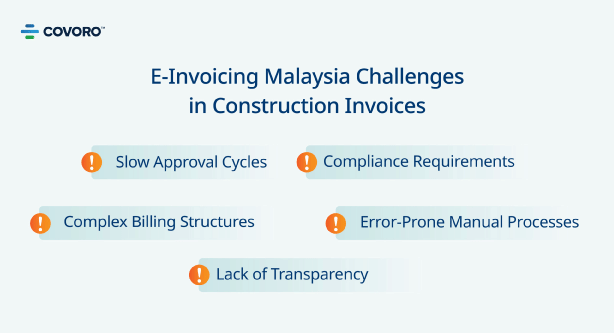
Managing invoices in the construction industry is no easy feat. Complex billing structures, numerous stakeholders, and stringent compliance requirements under E-Invoicing Malaysia often lead to errors and inefficiencies, disrupting cash flow and delaying project timelines.
Key Challenges
Complex Billing Structures
Handling progress payments, variation orders, and retention sums demands meticulous tracking and accurate documentation—now addressed under section 8.3 of the e-invoice specific guideline.
Error-Prone Manual Processes
Manual data entry increases the likelihood of inaccuracies, which can result in disputes and payment delays.
Slow Approval Cycles
Lengthy validation processes hinder timely approvals and disrupt cash flow management.
Compliance Requirements
Adhering to E-Invoicing Malaysia standards such as LHDN e invoice and Peppol requires significant effort and precision to avoid penalties.
Lack of Transparency
Limited visibility into invoice statuses creates miscommunication among contractors, subcontractors, and suppliers, leading to uncertainty and inefficiencies.
E-Invoicing Malaysia Transforms Construction Invoices
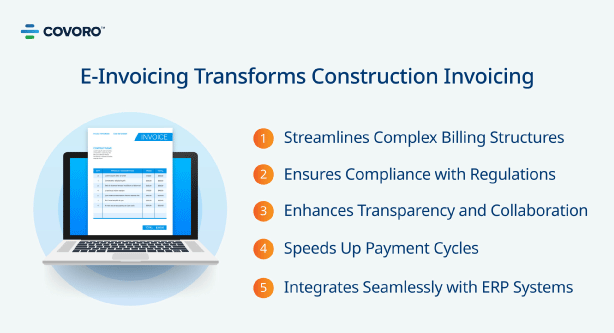
The construction industry in Malaysia faces significant invoicing challenges due to its complex billing structures and the involvement of multiple stakeholders. E-Invoicing Malaysia, as part of the country's digital transformation initiative, provides a streamlined solution, enhancing compliance and operational efficiency for construction businesses.
Streamlines Complex Billing Structures
Automates progress payments, variation orders, and retention sums, reducing manual effort and the risk of errors. This automation is crucial for compliance with the Income Tax (Construction Contracts) Regulations 2007.
Ensures Compliance with Regulations
Aligns with E-Invoicing Malaysia standards like LHDN e invoice and Peppol, mitigating risks related to non-compliance and ensuring adherence to section 8.3 of the e-invoice specific guideline.
Enhances Transparency and Collaboration
Offers real-time access to invoice statuses through e-invoice portals, improving communication and coordination among stakeholders.
Speeds Up Payment Cycles
Accelerates approval processes and reduces delays, ensuring improved cash flow management for ongoing projects.
Integrates Seamlessly with ERP Systems
Works with existing accounting and project management tools, unifying operations and simplifying tracking.
Understanding E-Invoicing Requirements for Construction Companies in Malaysia
E-invoicing is a significant shift for construction companies in Malaysia as the government implements its digital invoicing mandate. For an industry with complex billing and multiple stakeholders, understanding the requirements is key to staying compliant and efficient.
Compliance with LHDN and Peppol standards is essential. Construction businesses must ensure their invoices are validated and formatted according to these standards for seamless processing.
Specific document types like progress payment certificates, subcontractor invoices, and retention invoices must now be submitted digitally, adhering to the e-invoicing framework.
Integration with existing ERP systems is crucial for streamlining data management, ensuring that e-invoicing aligns with the company's existing workflows.
Finally, construction companies must follow the phased rollout timelines set by the government, ensuring timely adoption to avoid penalties and operational disruptions.
By meeting these requirements, businesses can unlock the full potential of e-invoicing, paving the way for smoother operations and better financial management.
Features of Malaysia's E-Invoicing System for the Construction Industry
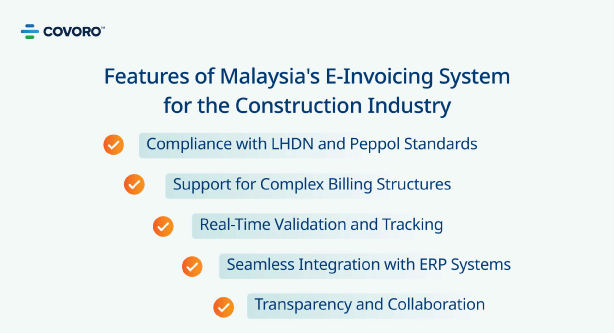
The construction industry, with its intricate billing processes and numerous stakeholders, stands to gain immensely from E-Invoicing Malaysia. This system is tailored to meet the unique needs of construction businesses, streamlining and modernizing invoicing procedures for enhanced efficiency. Following are some key features mentioned below :
Compliance with LHDN and Peppol Standards
Ensures all invoices adhere to Malaysia's Inland Revenue Board (LHDN) and Peppol standards, reducing errors and enabling smooth validation and submission processes.
Support for Complex Billing Structures
Accommodates construction-specific invoices such as progress payment certificates, variation orders, and retention invoices, making it ideal for managing layered billing processes.
Real-Time Validation and Tracking
Provides real-time validation of invoices, offering immediate feedback on errors or discrepancies, helping construction companies avoid delays in approval and payment cycles.
Seamless Integration with ERP Systems
Integrates effortlessly with popular ERP and accounting software, allowing businesses to manage invoicing and financial data on a unified platform.
Transparency and Collaboration
Offers digital access to invoices and payment statuses, improving transparency among contractors, subcontractors, and suppliers, fostering better communication and reducing disputes.
Can E-Invoicing Improve Collaboration Between Contractors and Subcontractors in Malaysia?
In the construction industry, smooth collaboration between contractors and subcontractors is essential for project success. Traditional invoicing methods often lead to miscommunication, delayed payments, and disputes, creating obstacles in this critical relationship. E-Invoicing Malaysia offers a digital solution to address these challenges and enhance collaboration.
How E-Invoicing Malaysia Enhances Collaboration
Transparency in Transactions
Provides real-time invoice tracking, ensuring contractors and subcontractors have a clear view of payment timelines and approval processes.
Error Reduction
Automated validation minimizes errors, preventing disputes caused by incorrect amounts or missing information.
Streamlined Communication
Digital invoices maintain a centralized record of transactions, enabling better coordination and accessibility for all stakeholders.
Faster Payment Cycles
Automates approval workflows, reducing payment delays and fostering trust and reliability between contractors and subcontractors.
Standardization of Processes
Ensures invoices follow a uniform format, making it easier for all parties to manage and process them efficiently.
Step-by-Step Guide to Adopting E-Invoicing in the Construction Industry
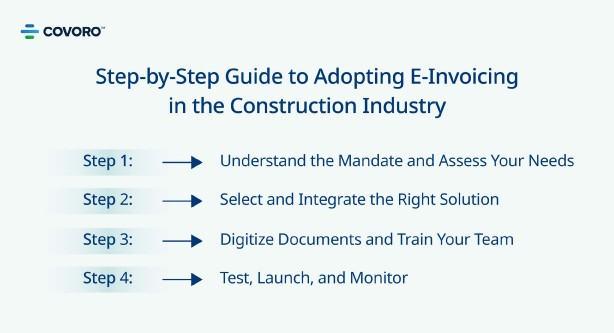
Adopting e-invoicing in the construction industry is a crucial move toward enhancing efficiency and ensuring compliance. With Malaysia's phased rollout of e-invoicing mandates, construction businesses must align their operations with digital invoicing standards to stay competitive. Here's how you can get started:
Understand the Mandate and Assess Your Needs
Familiarize yourself with Malaysia's e-invoicing requirements, including compliance with LHDN and Peppol standards. Analyze your current invoicing processes to identify challenges like manual errors, delays, or lack of transparency.
Steps:
-
Review LHDN e invoice guidelines, including section 8.3 of the e-invoice specific guideline.
- Identify inefficiencies in your current invoicing workflow.
Select and Integrate the Right Solution
Choose an e-invoicing system that supports construction-specific billing structures and integrates seamlessly with your existing ERP or accounting tools.
Steps:
- Look for software compliant with LHDN and Peppol standards.
- Ensure it can handle progress payments, retention invoices, and variation orders.
- Integrate with ERP systems for unified operations.
Digitize Documents and Train Your Team
Transition your paper-based invoicing to digital formats and prepare your team for the shift. Training ensures smooth adoption and minimizes resistance to change.
Steps:
- Create standardized templates for key construction invoices.
- Conduct workshops to train employees on using the e-invoicing system.
Test, Launch, and Monitor
Before full implementation, test the e-invoicing system with a small set of invoices. Once live, monitor its performance to optimize processes and address any issues.
Steps:
- Conduct a pilot run to identify and resolve potential errors.
- Roll out the system gradually, starting with specific projects.
- Regularly monitor performance and gather user feedback.
Cost-Benefit Analysis of E-Invoicing for Construction Companies in Malaysia
Implementing e-invoicing might seem like a significant investment for construction companies, but the long-term benefits far outweigh the costs. A detailed cost-benefit analysis can help businesses understand the financial and operational value of transitioning to a digital invoicing system.
Costs of Implementing E-Invoicing
-
Initial Setup Costs:
-
Software licensing or subscription fees.
-
ERP system integration and customization costs.
-
Hardware upgrades, if necessary.
-
Training and Onboarding:
-
Employee training programs to ensure smooth adoption.
-
Temporary productivity dips during the transition phase.
-
Ongoing Maintenance:
-
System updates to stay compliant with LHDN and Peppol standards.
-
Annual support and technical assistance fees.
Benefits of E-Invoicing
-
Operational Efficiency:
-
Automates manual procedures, saving time and decreasing human mistakes.
-
Streamlines complex billing structures like progress payments and variation orders.
-
Faster Payment Cycles:
-
Reduces delays in invoice approvals, improving cash flow for ongoing projects.
-
Enhances supplier and subcontractor relationships through timely payments.
-
Regulatory Compliance:
-
Ensures adherence to LHDN and Peppol standards, avoiding penalties.
-
Simplifies audit processes with easily accessible digital records.
-
Improved Transparency:
-
Real-time tracking of invoices provides better visibility for all stakeholders.
-
Encourages trust and collaboration between contractors, subcontractors, and suppliers.
Weighing the Costs Against the Benefits
Example:
A mid-sized construction company spends RM 50,000 annually on manual invoicing, including labour and dispute resolution costs. By implementing an e-invoicing system for RM 30,000 initially (including training and setup), the company reduces manual effort, avoids disputes, and accelerates payments, saving RM 20,000 in the first year alone.
Covoro.ai : The Advanced E-Invoicing Solution for Malaysia's Construction Industry
Covoro.ai offers a cutting-edge e-invoicing solution designed to tackle the unique challenges faced by the construction sector while ensuring full compliance with E-Invoicing Malaysia mandates. Here's how Covoro.ai can transform your invoicing processes:
Seamless Compliance with LHDN e invoice and Peppol Standards
- Ensures all invoices align with Malaysia's regulatory requirements, avoiding non-compliance penalties.
- Automates document validation, simplifying adherence to E-Invoicing Malaysia standards.
Integration with ERP Systems
- Compatible with over 100 ERP systems, including SAP, Oracle, and Tally.
- Facilitates smooth data flow between invoicing and project management tools for unified operations.
Real-Time Invoice Validation and Tracking
- Provides instant feedback on invoice statuses, reducing approval delays.
- Enhances transparency among contractors, subcontractors, and suppliers.
Enhanced Operational Efficiency
- Enables bulk invoice generation for faster processing of high-volume transactions.
- Validates multiple data points automatically, saving time and resources.
Cost Savings and Better Cash Flow Management
- Minimizes manual errors, disputes, and associated costs.
- Speeds up payment cycles, ensuring timely cash flow for ongoing projects.
User-Friendly Dashboard
- Features an intuitive interface for monitoring invoicing activities and compliance updates.
- Delivers actionable insights to streamline decision-making processes.
Conclusion
Covoro.ai provides a powerful e-invoicing solution tailored for Malaysia's construction industry, addressing the sector's unique challenges. Designed to comply with E-Invoicing Malaysia mandates, it ensures adherence to LHDN and Peppol standards while automating complex billing processes like progress payments and variation orders.
Seamlessly integrating with ERP systems, Covoro.ai simplifies data management and enhances operational efficiency. With features such as real-time invoice validation, bulk generation, and a user-friendly dashboard, it streamlines cash flow management and fosters better collaboration among contractors and subcontractors.
By leveraging E-Invoicing Malaysia, construction companies can reduce errors, stay compliant, and optimize their operations for growth in the digital economy.
FAQ on E-invoice Implementation for Malaysia Construction Industry
1. Is E-Invoicing Mandatory in Malaysia?
Yes, e-invoicing is being rolled out in phases in Malaysia. The mandate requires businesses to comply with the Inland Revenue Board of Malaysia (LHDN) and Peppol standards to ensure digital invoicing processes.
2. What Are the Rules for Invoices in Malaysia?
Invoices in Malaysia must comply with LHDN regulations, including precise details like invoice number, date, supplier and buyer information, itemized charges, and applicable tax information. For e-invoices, adherence to Peppol standards is required.
3. Who Is Eligible for E-Invoice in 2024?
In 2024, the eligibility for e-invoicing includes businesses meeting turnover thresholds specified by the government under the phased rollout plan. Construction companies, regardless of size, are required to adopt e-invoicing if they meet these criteria.
4. How Do I Invoice for Construction Work?
To invoice for construction work, include details like project name, scope of work, progress completed, payment terms, and applicable taxes. Using an e-invoicing system ensures accuracy and compliance with Malaysia's digital invoicing requirements.
5. How to Make a Bill of Construction Work?
A bill for construction work should outline labour costs, materials used, project milestones, and any variation orders. E-invoicing systems can automate this procedure, declining mistakes and assuring compliance.
6. Do Contractors Send Invoices?
Yes, contractors are responsible for sending invoices to clients for the work completed. E-invoicing allows contractors to issue compliant digital invoices, ensuring timely payments and transparency.
7. What Is the Construction Billing Process?
The construction billing process includes generating invoices for progress payments, retention amounts, and variation orders. E-invoicing streamlines this process by automating document generation and tracking payment statuses in real-time.
8. Who Processes Invoices?
Invoices are typically processed by the finance or accounts payable team of a business. In construction projects, e-invoicing systems facilitate faster approvals and accurate tracking by automating these tasks.
9. Who Will Prepare the Invoice?
In construction, invoices are usually prepared by contractors or the project management team detailing the work completed and costs incurred. An e-invoicing solution simplifies and standardizes this process.
10. How to Prepare an E-Invoice?
To prepare an e-invoice, input details such as project description, charges, and tax information into an e-invoicing system. Ensure compliance with LHDN and Peppol standards and validate the invoice digitally before submission.
Categories
You Might Also Like