E-Invoicing Integration in Malaysia’s Insurance and Takaful Industry

Table of Content
- What Are the Challenges in E-Invoicing Integration in the Insurance and Takaful Industry?
- How Can Insurance and Takaful Operators Overcome E-Invoicing Challenges?
- How Does E-Invoicing Apply to the Insurance and Takaful Industry?
- How Covoro.ai Simplifies E-Invoicing for Malaysia's Insurance and Takaful Industry
- Conclusion and FAQ's
E-invoicing integration is transforming how businesses manage financial transactions. It eliminates manual paperwork, reduces errors, and ensures better tax compliance. This shift is a crucial step toward efficiency and transparency for the insurance and Takaful industry.
Handling policy premiums, claims, payouts, and commissions involves multiple invoicing processes. With e-invoices, these transactions can be processed faster and with greater accuracy. It will help reduce delays and improve financial tracking.
However, adopting e-invoicing comes with challenges. Many companies still use outdated systems that may not support e-invoice generation. Compliance with LHDN e invoice guideline and data security are also significant concerns.
A well-planned approach can make the transition smoother. Upgrading systems, automating e-invoice generation, and training employees are key steps. Understanding the implementation process will help insurers and Takaful operators adapt successfully.
Regulatory Framework and Compliance Requirements
1. LHDN's E-Invoicing Mandate for Insurance & Takaful
The Malaysian Inland Revenue Board (LHDN) has mandated e-invoicing for businesses, including the insurance and Takaful sectors. This mandate ensures that all business transactions are reported digitally, simplifying tax reporting and enhancing compliance.
This involves generating e-invoices for transactions such as premiums, claims, and commissions for the insurance industry.
For a comprehensive understanding of regulatory requirements, refer to the e-Invoicing Malaysia: A Complete Guide to Compliance by Covoro.ai.
2. E-Invoice Format and Details
E-invoices must adhere to LHDN's prescribed formats, such as XML or JSON. The e-invoice needs to include essential details to meet regulatory standards:
- Tax details: GST, service tax, or any applicable taxes
- Transaction description: Clear breakdown of what the e-invoice represents
- Digital authentication: Ensures invoice authenticity and prevents fraud
You can refer to the e invoicing Malaysia guidelines pdf issued by LHDN for a comprehensive understanding of technical and regulatory requirements.
3. System Integration for Seamless E-Invoice Generation
Successful E-Invoicing Integration requires insurance and Takaful operators to align their policy management platforms, accounting software, and reinsurance systems with LHDN’s e-invoicing framework.
This integration ensures that transactions like policy premiums, claims payouts and reinsurance agreements are captured accurately, minimizing the risk of errors and delays in reporting to LHDN.
4. Ongoing Compliance and Monitoring
To ensure continuous compliance with LHDN's evolving guidelines, insurance and Takaful operators need to implement automated systems to validate e-invoices.
Regularly monitoring updates from LHDN is crucial to ensure that the e-invoicing system remains in line with any regulatory changes or new tax reporting requirements.
5. Consequences of Non-Compliance
Failure to comply with LHDN's e-invoicing standards can result in serious consequences for the insurance and Takaful sectors. These include:
- Penalties and fines for late or inaccurate compliances
- Delays in processing claims or financial transactions
- Legal repercussions for not adhering to mandatory regulations
What Are the Challenges in E-Invoicing Integration in the Insurance and Takaful Industry?
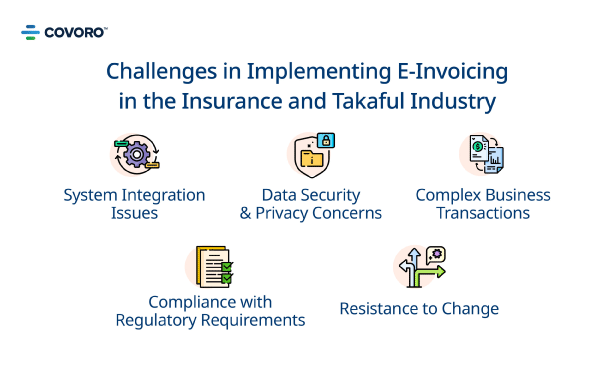
While the move towards e-invoicing offers multiple benefits, its adoption presents several challenges, particularly in the insurance and Takaful industry:
System Integration Issues
-
Many insurers and Takaful operators rely on legacy systems that may not be compatible with LHDN's e-invoicing framework.
-
Upgrading or substituting these systems can be expensive and time-consuming.
Data Security & Privacy Concerns
-
E-invoicing involves the exchange of sensitive policyholder data, requiring robust cybersecurity measures.
-
Ensuring compliance with Malaysia's Personal Data Protection Act (PDPA) is crucial.
Complex Business Transactions
-
Insurance and Takaful companies deal with diverse transactions, including policy premiums, reinsurance agreements, claims payouts, and commissions.
-
Ensuring that all these transactions are accurately captured under e-invoicing can be challenging.
Compliance with Regulatory Requirements
-
Companies must ensure that e-invoices meet LHDN's prescribed format (such as XML or JSON).
-
Non-compliance could lead to penalties or delays in processing financial transactions.
Resistance to Change
-
Employees, intermediaries, and policyholders may struggle to adapt to the new digital e-invoicing system.
-
Training and stakeholder engagement are necessary to ensure smooth adoption.
How Can Insurance and Takaful Operators Overcome E-Invoicing Challenges?
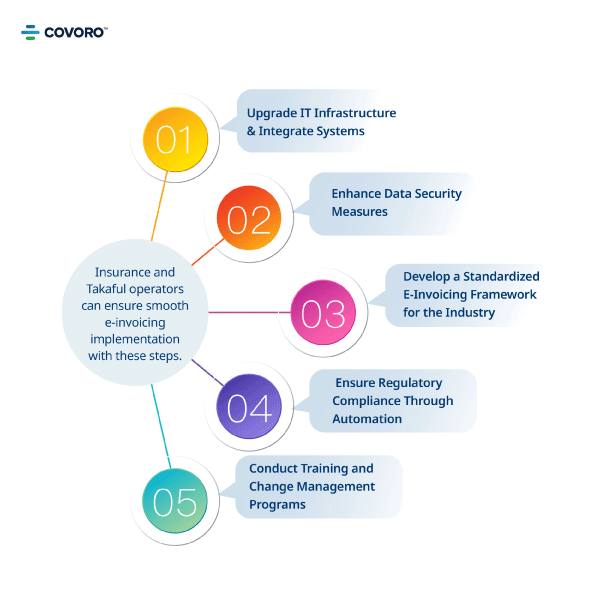
To ensure the smooth implementation of e-invoicing, insurance, and Takaful operators can take the following steps:
Upgrade IT Infrastructure & Integrate Systems
-
Invest in e-invoicing software that seamlessly integrates with existing ERP and accounting systems.
-
Work with IT service providers to develop customized solutions that cater to industry-specific needs.
Enhance Data Security Measures
-
Implement encryption and access controls to protect sensitive policyholder and financial data.
-
Conduct regular cybersecurity audits and ensure compliance with PDPA regulations.
Develop a Standardized E-Invoicing Framework for the Industry
-
Collaborate with regulators, industry bodies, and stakeholders to define e-invoicing standards that cater to the unique needs of insurers and Takaful operators.
-
Ensure that e-invoices for different types of transactions (such as claims payouts and commissions) comply with LHDN's guidelines.
Ensure Regulatory Compliance Through Automation
-
Implement automation tools that validate e-invoices before submission to LHDN to avoid errors and delays.
-
Stay updated on tax authority guidelines and participate in industry discussions to ensure compliance.
Conduct Training and Change Management Programs
-
Organize workshops for employees, agents, and brokers to familiarize them with the new e-invoicing system.
-
Develop user-friendly guides and FAQs to assist stakeholders in adopting e-invoices.
What Are the Benefits of E-Invoicing for Insurance and Takaful Operators?
Despite the challenges, the implementation of e-invoicing brings several advantages:
Improved Compliance and Transparency
Reduces manual errors and ensures accurate tax reporting, minimizing the risk of penalties.
Increased Operational Efficiency
Reduces paperwork and speeds up e-invoice processing, allowing for faster transactions.
Enhanced Fraud Prevention
Digital e-invoices lessen the chances of invoice manipulation, improving financial security.
Seamless Financial Integration
E-invoicing can be integrated with policy management and claims processing systems for real-time tracking.
Cost Savings on Administrative Processes
Automating e-invoice generation and submission reduces administrative overhead.
How Does E-Invoicing Apply to the Insurance and Takaful Industry?
E-invoicing applies to various revenue and expense transactions in the insurance and Takaful sector.
Revenue Sources Requiring E-Invoicing
-
Policy Premiums
-
Reinsurance Agreements
-
Claims Management Fees
-
Underwriting Services
-
Commissions from Agents and Brokers
-
Profit-sharing from Takaful Pools
-
Administrative Fees
Expenses Covered by E-Invoicing
-
Claims Payouts
-
Reinsurance Premiums
-
Commissions Paid to Agents and Brokers
-
Regulatory Fees and Taxes
What Are the Key Steps for Insurance and Takaful Operators to Ensure E-Invoicing Compliance?
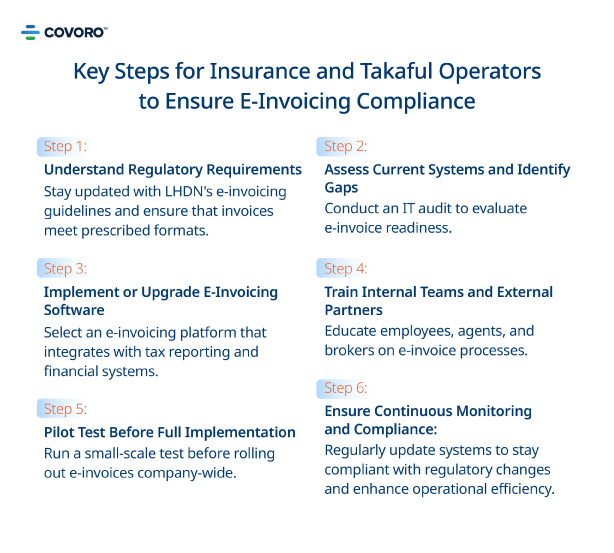
Insurance and Takaful operators should follow these steps to ensure a smooth transition to e-invoicing:
Understand Regulatory Requirements:
Stay updated with LHDN's e-invoicing guidelines and ensure that invoices meet prescribed formats.
Assess Current Systems and Identify Gaps:
Conduct an IT audit to evaluate e-invoice readiness.
Implement or Upgrade E-Invoicing Software:
Select an e-invoicing platform that integrates with tax reporting and financial systems.
Train Internal Teams and External Partners:
Educate employees, agents, and brokers on e-invoice processes.
Pilot Test Before Full Implementation:
Run a small-scale test before rolling out e-invoices company-wide.
Ensure Continuous Monitoring and Compliance:
Regularly update systems to stay compliant with regulatory changes and enhance operational efficiency.
How Covoro.ai Simplifies E-Invoicing for Malaysia's Insurance and Takaful Industry
Covoro.ai is a cutting-edge e-invoicing solution tailored to help businesses seamlessly transition to digital invoicing, including those in Malaysia's insurance and Takaful sector. Here's how Covoro.ai can transform your e-invoicing process:
Seamless Integration with Existing Systems
Covoro.ai effortlessly integrates with your current ERP and accounting platforms, ensuring a smooth transition to e-invoicing without disrupting your operations. This particularly benefits insurance and Takaful operators who are managing complex transactions like policy premiums, claims payouts, and commissions.
Compliance with LHDN Regulations
Covoro.ai ensures that all e-invoices adhere to LHDN's mandated formats, such as XML or JSON. The platform automates the generation, validation, and submission of e-invoices, reducing the risk of errors and ensuring timely compliance with tax regulations.
Enhanced Data Security
With robust encryption and access controls, Covoro.ai safeguards sensitive policyholder and financial data, ensuring compliance with Malaysia's Personal Data Protection Act (PDPA). Regular cybersecurity audits further strengthen data protection.
Fraud Prevention
Digital e-invoices generated through Covoro.ai reduce the risk of invoice manipulation, enhancing financial security and transparency.
Scalability for Diverse Transactions
Whether policy premiums, reinsurance agreements, or claims payouts, Covoro.ai is designed to handle the diverse and complex transactions typical of the insurance and Takaful industry.
Why Choose Covoro.ai?
- Regulatory Compliance: Stay updated with LHDN's evolving guidelines.
- Operational Efficiency: Streamline invoicing processes and reduce manual effort.
- Data Security: Protect sensitive information with advanced cybersecurity measures.
- Cost-Effective: Save on administrative costs and avoid penalties.
By leveraging Covoro.ai, insurance, and Takaful operators can overcome e-invoicing challenges, ensure compliance, and position themselves for long-term success in Malaysia's digital economy.
Is your company ready to embrace e-invoicing? Let Covoro.ai guide your transformation.
Conclusion
The adoption of E-Invoicing Integration in Malaysia’s insurance and Takaful industry marks a significant step toward digital transformation, transparency, and efficiency. While the transition presents challenges, companies can overcome them with the right technology, proper training, and regulatory compliance measures.
By proactively implementing e-invoicing, insurance and Takaful operators can enhance operational efficiency, improve tax compliance, and position themselves for long-term success in the digital era.
Is your company ready for e-invoicing? Now is the time to prepare and embrace this transformation
FAQ On E-invoicing Integration for the Insurance and Takaful Industry in Malaysia
1. Is e-invoicing mandatory in Malaysia for insurance agents?
Yes, e-invoicing is mandatory in Malaysia for insurance agents, but the requirement depends on their annual turnover based on the implementation timeline issued by LHDN (Inland Revenue Board of Malaysia).
2. Can insurance companies issue a single consolidated e-invoice for multiple policies sold to customers who do not need an e-invoice?
Yes, insurers can issue a consolidated e-invoice for policyholders who do not require one. That will simplify tax reporting while ensuring compliance with LHDN regulations. Insurers should refer to Section 3.6 of the e-Invoice Specific Guideline for proper procedures.
3. Can an annual premium statement serve as a consolidated e-invoice?
Yes, annual premium statements can be used for consolidated e-invoicing when policyholders do not request individual invoices. These must be submitted for validation within seven (7) days after the issuance month, which will ensure compliance while maintaining smooth financial operations.
4. If a policyholder requests an e-invoice for a product that is not tax-deductible, does the insurance company still need to issue one?
Yes, insurers must provide an e-invoice upon request, even if the product is ineligible for tax relief. Policyholders are considered buyers in e-invoicing, and their requests must be honored. That maintains transparency and compliance with tax regulations.
5. How should insurers handle e-invoices for joint insurance policies with multiple policyholders?
The primary policyholder should be listed as the buyer in the e-invoice. If another policyholder requests one, the insurer must issue a separate e-invoice, which ensures proper documentation while complying with LHDN requirements.
6. When an insurance policy is terminated, should an e-invoice be issued for the refunded premium?
Yes, a refund note e-invoice must be issued for returned premiums upon policy termination. Exceptions apply for mistaken payments, overpayments, or security deposit refunds. Insurers must ensure compliance with LHDN's e-invoicing guidelines.
7. If a policyholder is under 18 years old, whose details should be used on the e-invoice?
For minor policyholders, the e-invoice should use the parent's or guardian's details. Minors cannot be listed as buyers for tax purposes under e-invoicing rules. It ensures compliance while maintaining accurate financial records.
8. How should e-invoicing be handled when employers collect insurance contributions on behalf of employees?
If the employee is the policyholder, the e-invoice must be issued to the employee, not the employer. The employer is only a payment collector, not the buyer. So it will comply tax documentation correctly reflects the policyholder's financial responsibility.
9. Will the implementation of e-invoicing change the cash-before-cover policy for insurance companies?
No, insurers can continue their cash-before-cover policy without changes. They must still ensure e-invoices are generated at the correct transaction stage. Existing invoicing and payment processes remain valid under the new system.
10. How should insurers manage e-invoicing for reinsurance services and expense recoveries from reinsurance companies?
If the reinsurer is in Malaysia, they must issue an e-invoice to the insurance company. If the reinsurer is overseas, the insurer must generate a self-billed e-invoice. So, it ensures compliance with LHDN's e-invoicing framework.
11. Are insurance claim and compensation payment subject to e-invoicing?
Yes, insurers must issue self-billed e-invoices for claims, benefits, and compensation payouts. So, it will apply even if payments go directly to hospitals, workshops, or third parties. Consolidated self-billed e-invoices can be used for non-business policyholders.
12. Where can I find technical details about e-invoicing?
You can find simple technical details about e-invoicing in Malaysia on LHDN’s e-Invoice Portal. It includes guidelines, API details, and Peppol format instructions. You can also use the MyInvois Portal for manual invoices or connect through Peppol service providers.
Categories
You Might Also Like