E Invoicing Software in Malaysia: Strategies for E-Commerce Success
Table of Content
- Why Is E-Invoicing Crucial for E-Commerce in Malaysia?
- What Should You Know About Malaysia's E-Invoicing Framework?
- Strategies for Successful E-Invoice Implementation in Malaysia's E-Commerce Sector
- How Are Technological Innovations Shaping E-Invoicing for Malaysia's E-Commerce Industry?
- Conclusion and FAQ's
Malaysia's e-commerce landscape is rapidly evolving, and e-invoicing Malaysia is set to bring significant changes. The government mandate requires businesses to adopt a fully digital invoicing system, reshaping how transactions are managed across industries.
To ensure a smooth transition, companies must familiarize themselves with the e-invoicing Malaysia guidelines outlined by the Inland Revenue Board of Malaysia (LHDN). These e-invoice guidelines provide businesses with clear instructions on invoice validation, submission processes, and storage requirements under the new system.
For e-commerce players, this shift offers both challenges and opportunities. E-Invoicing Malaysia streamlines invoice management, ensures regulatory compliance, and enhances transparency. These advancements not only build trust with customers but also improve operational efficiency, enabling businesses to stay competitive.
Why Is E-Invoicing Crucial for E-Commerce in Malaysia?
E-Invoicing Malaysia isn't just another regulatory requirement—it's a game changer. Under the Malaysian government's E-Invoicing Malaysia mandate, businesses must transition from traditional invoicing methods to a fully digital format.
The system, governed by E invoice LHDN, ensures that all transactions are validated in real-time, reducing fraud and simplifying tax compliance. Businesses that align with the e-invoicing Malaysia guidelines benefit from improved transparency and streamlined operations, both of which are essential in today’s competitive e-commerce environment.
This shift is designed to increase tax compliance, reduce fraud, and simplify the invoicing process for both businesses and the government. Embracing E-Invoicing Malaysia offers opportunities for greater transparency, operational efficiency, and long-term cost savings while ensuring compliance with the latest regulations.
What Are the Key Benefits of E-Invoicing for E-Commerce Businesses?
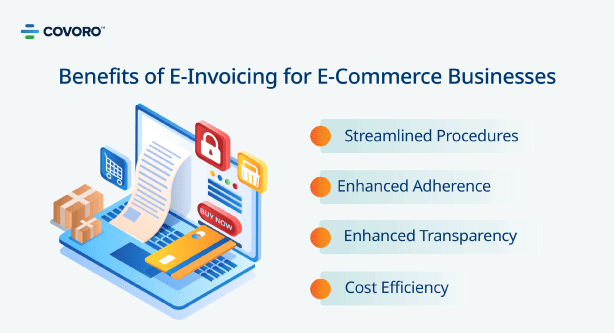
The implementation of E-Invoicing Malaysia is revolutionizing how e-commerce businesses manage their invoicing workflows. By shifting to a fully digital platform, companies can unlock numerous benefits that enhance efficiency, compliance, and transparency. Here's how:
-
Streamlined Procedures: Say goodbye to manual data entry and paper invoices. E-Invoicing Malaysia enables automated workflows, saving time and effort.
-
Enhanced Adherence: Automate tax reporting to comply with regulations effortlessly and avoid costly penalties.
-
Enhanced Transparency: Real-time validation of invoices ensures accuracy and builds trust among customers and business partners.
-
Cost Efficiency: Reduce administrative expenses and free up resources to focus on strategic business initiatives.
What Should You Know About Malaysia's E-Invoicing Framework?
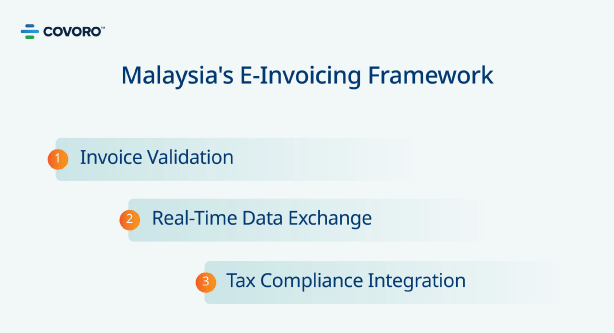
E-Invoicing Malaysia operates on the Continuous Transaction Control (CTC) model, which is designed to streamline invoicing and enhance compliance. This framework requires every invoice to be validated by the Inland Revenue Board (LHDN) platform before being sent to the buyer. Applicable to both B2B and B2C transactions, the system is being implemented in phases to ensure a smooth transition for businesses.
Key Elements of the Framework:
-
Invoice Validation: Each invoice is thoroughly checked for compliance and accuracy under E-Invoicing Malaysia standards.
-
Real-Time Data Exchange: Businesses are required to send invoice data to LHDN in real time to ensure up-to-date reporting.
-
Tax Compliance Integration: Automatic validation of tax details minimizes errors and simplifies compliance processes.
How E-Invoicing Impacts the Jewellery Business
The jewellery industry faces unique invoicing challenges, particularly regarding high-value transactions and tax compliance. E Invoice for jewellery business simplifies:
- GST compliance for high-ticket sales
- Accurate valuation reporting
- Fraud prevention through digital invoice tracking
Adopting e invoicing software ensures jewelry businesses remain compliant while improving customer trust and transparency.
What Are the Implications of E-Invoicing for Malaysia's E-Commerce Industry?
The e-commerce industry, with its high transaction volumes, dynamic pricing models, and extensive cross-border trade, faces unique challenges that make E-Invoicing in Malaysia both a necessity and a transformative solution. Here's how E-Invoicing Malaysia addresses these challenges:
Challenges Addressed by E-Invoicing:
High Transaction Volume:
Managing thousands of transactions daily through manual invoicing often results in errors and delays.
E-Invoicing Malaysia Solution:
Automated validation and bulk upload capabilities streamline invoicing workflows, reducing errors and saving time.
Dynamic Pricing Models:
Frequent discounts, flash sales, and promotional campaigns can create discrepancies in manually generated invoices.
E-Invoicing Malaysia Solution:
Real-time pricing updates ensure invoices are accurate and align with dynamic pricing changes.
Cross-Border Transactions:
Dealing with multiple tax jurisdictions and currencies in cross-border trade adds complexity to invoicing.
E-Invoicing Malaysia Solution:
Automated systems handle tax calculations and currency conversions seamlessly, simplifying international operations.
How E-Invoicing Malaysia Transforms E-Commerce Operations
The adoption of e-invoicing solutions in Malaysia is reshaping e-commerce operations, offering numerous opportunities for businesses to enhance efficiency and compliance. Here's how:
-
Order Administration
Automating the invoicing process ensures orders are processed quickly and with greater accuracy, which will lead to faster customer fulfillment, a critical factor in Malaysia's competitive e-commerce landscape.
-
Vendor Coordination
E-commerce platforms with multiple vendors benefit greatly from consolidated invoicing processes. E-invoicing Malaysia solutions enhance transparency and reduce disputes, fostering better coordination between platform operators and vendors.
-
Returns and Refunds
Managing returns and refunds can be complex in e-commerce. Automated e-invoicing simplifies tracking and ensures compliance with tax adjustments, aligning with Malaysia’s regulatory requirements for seamless operations.
-
Payment Reconciliation
Integrating e-invoicing Malaysia solutions with payment gateways enables businesses to streamline reconciliation processes, reducing revenue leakages and providing real-time insights into cash flow and financial performance.
Strategies for Successful E-Invoice Implementation in Malaysia's E-Commerce Sector
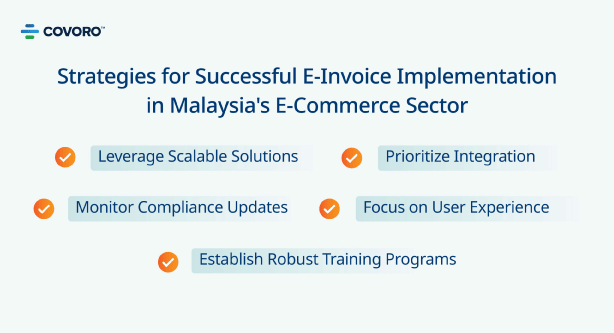
Adopting e-invoicing Malaysia solutions in the e-commerce sector requires a well-thought-out strategy to ensure seamless operations and compliance with regulations. Here are the key strategies for successful implementation:
Leverage Scalable Solutions: Choose e-invoicing platforms designed to scale with your business growth. These are particularly important during peak sales seasons, ensuring that the system can handle high transaction volumes without disruptions.
Prioritize Integration: Seamlessly integrate your e-invoicing Malaysia solution with existing ERP, CRM, and inventory management systems. Ensures operational efficiency, reduces manual work, and minimizes errors in data flow.
Monitor Compliance Updates: Stay informed about the latest LHDN (Inland Revenue Board of Malaysia) regulations to avoid non-compliance penalties. Regularly updating your system to meet these requirements ensures smooth and legally compliant transactions.
Focus on User Experience: Implement customizable invoice templates that align with your brand identity while adhering to e-invoicing Malaysia standards. A well-designed invoice not only ensures compliance but also enhances your brand’s professionalism.
Establish Robust Training Programs: Equip your finance and operations teams with a thorough understanding of e-invoicing Malaysia workflows. Comprehensive training programs can minimize disruptions during the transition and ensure that your staff is well-prepared for the shift.
How Are Technological Innovations Shaping E-Invoicing for Malaysia's E-Commerce Industry?
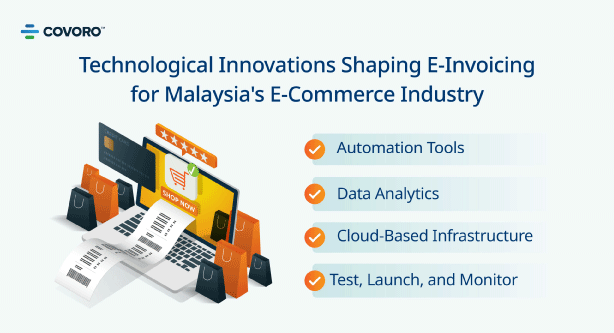
Technological advancements are revolutionizing e-invoicing, offering solutions that enhance efficiency, accuracy, and compliance. By integrating modern tools and platforms, e-commerce businesses in Malaysia can streamline their invoicing processes, reduce manual intervention, and improve overall operational performance. Here are some essential inventions driving this conversion:
-
Automation Tools: Automate invoice generation and validation to reduce processing time and errors.
-
Data Analytics: Leverage analytics to track invoicing patterns, identify discrepancies, and optimize processes.
-
Cloud-Based Infrastructure: Use cloud platforms for secure, real-time access to invoicing data across multiple locations.
-
Mobile Accessibility: Enable mobile-friendly e-invoicing platforms for remote management and approvals.
How Covoro.ai Supports Malaysia's E-Commerce Businesses with E-Invoicing
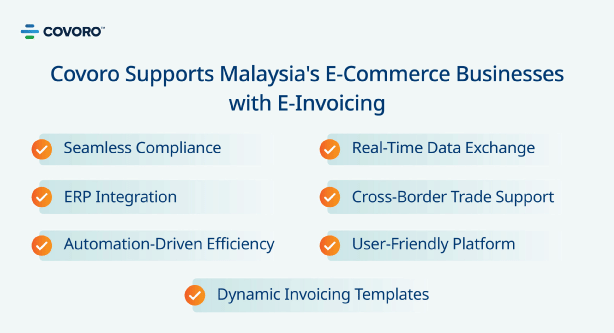
Covoro.ai simplifies the transition to e-invoicing for Malaysia's e-commerce industry, offering a comprehensive solution tailored to meet LHDN compliance while addressing the unique operational challenges of the sector.
- Seamless Compliance: Fully aligned with LHDN and PEPPOL standards, ensuring all invoices meet regulatory requirements.
- ERP Integration: Integrates effortlessly with popular ERP systems like SAP, Oracle, and Netsuite to streamline operations.
- Automation-Driven Efficiency: Automates invoice generation, validation, and tax calculations, reducing manual effort and errors.
- Dynamic Invoicing Templates: Supports customizable invoice templates for flash sales, discounts, and dynamic pricing scenarios.
- Real-Time Data Exchange: Enables instant invoice validation and submission to LHDN for smoother transaction workflows.
- Cross-Border Trade Support: Simplifies tax compliance and currency conversions for international transactions.
- User-Friendly Platform: Cloud-based and mobile-accessible for easy management across multiple locations.
Conclusion
E-invoicing is not merely a compliance requirement—it is a transformative force for Malaysia's e-commerce industry. By implementing robust e-invoicing solutions, businesses can enhance efficiency, improve compliance, and deliver a superior customer experience.
As the mandate takes effect, e-commerce players have the opportunity to lead the charge in digital transformation. The future of e-commerce in Malaysia depends on embracing these advancements now. Are you ready to redefine your invoicing process and secure your competitive edge?
FAQ On E-Invoice Implementation for Malaysia’s E-Commerce Industry
Is e-invoicing mandatory in Malaysia?
Yes, e-invoicing is mandatory in Malaysia under a phased implementation plan starting in 2024. Larger businesses are required to comply first, with smaller enterprises included by 2026. This mandate aims to enhance invoicing efficiency and transparency.
What are the rules for invoices in Malaysia?
Invoices in Malaysia must include details such as the seller's and buyer's names, invoice number, tax amount, and total cost. These details must adhere to FTA guidelines to ensure tax compliance and legal validity.
What is the timeline for e-invoice in Malaysia?
The implementation of e-invoicing in Malaysia begins in 2024, with a phased rollout extending to 2026. Larger companies with higher turnovers are the first to adopt, followed by smaller businesses. Each phase has specific criteria based on turnover thresholds.
What are the incentives for e-invoicing in Malaysia?
Malaysia incentivizes e-invoicing through tax deductions of up to RM50,000 annually for MSME ESG-related costs (including e-invoice consultation) from 2024-2027, and accelerated capital allowances for ICT equipment and software related to e-invoicing implementation. Beyond these financial incentives, businesses benefit from increased operational efficiency, cost savings through reduced paper use, improved regulatory compliance, and contributions to environmental sustainability.
Who is eligible for e-invoice in 2025?
In 2025, businesses exceeding the government-specified turnover threshold are required to adopt e-invoicing. This mandate primarily applies to larger enterprises to ensure compliance. Smaller businesses will be integrated into the system in later phases.
Who is exempted from e-invoicing?
Small businesses and specific industries may be exempt from mandatory e-invoicing based on government guidelines. Turnover limits and the nature of business operations determine exemptions. Exempted entities must still maintain proper documentation for audits.
What is the latest e-invoice applicability?
Currently, e-invoicing is applicable to B2B and B2G transactions. The government plans to expand it to include B2C transactions in future phases. Applicability depends on business turnover and transaction type.
Is an e-invoice mandatory for B2C?
At present, an e-invoice is not mandatory for B2C transactions in Malaysia. The initial rollout focuses on B2B and B2G transactions to establish a strong compliance structure. However, the inclusion of B2C may occur in later phases.
How many types of e-invoice are there?
There are two types of e-invoices in Malaysia: simplified and detailed. Simplified e-invoices are designed for low-value transactions with fewer data points, while detailed ones are used for high-value or complex transactions.
What if an e-invoice is not generated?
Failing to generate an e-invoice can lead to penalties, non-compliance notices, and operational disruptions. It can also harm a company's credibility and customer trust. Proactive compliance helps avoid fines and ensures smooth operations.
Is an Eway bill mandatory for an e-invoice?
An Eway bill is required for transporting goods above specified thresholds, and it operates independently of an e-invoice. While e-invoices focus on transaction documentation, Eway bills facilitate the movement of goods.
Categories
You Might Also Like